
Day 272: Who’s Asking?
I read an old story Rob Bell was retelling about a woman who went on a quest to find the answer to the question we all have, "who am I?".
She hiked up the mountain outside her village for days to find a yogi in a cave, only to have the yogi say it was too profound of a question for him to answer.
A few days later she finds another cave further up the mountain where an old saint lives. He also says the answer is beyond him.
She keeps going for several days, above the tree line where it's cold and windy until she arrives at another cave.
She finds an old woman alone on a rug. She asks the old woman, Who am I?
The old woman looks at her, arches her eyebrow, smiles and says, Who's asking?
Rob Bell found this story way funnier than I did.
But we both had the same thoughts about it.
It's about discovering the self behind the self, the who behind the who.
Most of what we call "me" is actually the outer layer.
The name.
The roles.
The story.
The preferences.
The body.
The current emotion.
The identity we have been answering to for years.
Behind the daily experiences we have is the self who is observing that self.
Around 40 years ago I first heard of the concept of the observer behind the person having the experience.
And then Deepak Chopra greatly expanded that topic for me.
We have emotions that we label as being us, I'm sad.
But is it really? Is that who you are? No.
You are observing sadness about something right now. Sadness is not you.
When we step back from our emotions and our experiences and realize they are occurring on the surface level of our experience, we also realize that they don't affect the you who is observing or the you who is watching that observer.
There are many levels of you.
The surface you is, well, just scratching the surface.
When we feel good we expand and feel that we are part of something bigger.
The better we feel, the more of the Universe we feel a part of.
And when we feel bad, we shrink and feel disconnected. We don't see the bigger picture.
And if something devastating happens, we can deny that anything outside of how we feel at that instant even exists. We completely shut down and crawl into our pain, who we then claim as us. I am….
Logically we know that isn't true. We can't be fully aligned with the Universe when we feel in love and then think we are the feelings we're having when we break up.
The alignment we had is always there waiting for us to join it. We only have to shift our vibration by remembering we are the observer who is observing the you having the experience, and really, so many more levels than even that.
When we take on the belief that we are all those levels of observer, then it's harder to get pulled out of our alignment when things happen that could devastate us.
We don't go down so far and we bounce back quicker, remmebrilgn that what we experience is based on the level we are vibrating at. And that is determined by our thoughts.
We are not just our name, where we're from, what we do for a living, or what we look like.
Those are identifiers, but not who we are.
The thing about the story is that the old woman asked the question right back because the woman had the answer all along.
She didn't need to trek up the mountain hoping some guru she had given her power to would tell her who she was.
The question, "Who am I?" can't be answered from the outside.
Someone else can describe what they see. They can tell you what they think you are. They can respond to your personality, your choices, your history, your appearance, your work, your mistakes, your gifts, or the role you play in their life.
But that is still their viewpoint. Their experience. Their interpretation. It may include pieces of truth, but it is not the whole of you.
Only you can answer who you are.
And the answer keeps deepening as you learn to see yourself from the place beneath the roles, beneath the emotions, beneath the story, beneath the version of you that other people think they know.
So maybe "Who's asking?" is the only answer that makes sense.
Because the one who is asking is also the one who is beginning to remember.
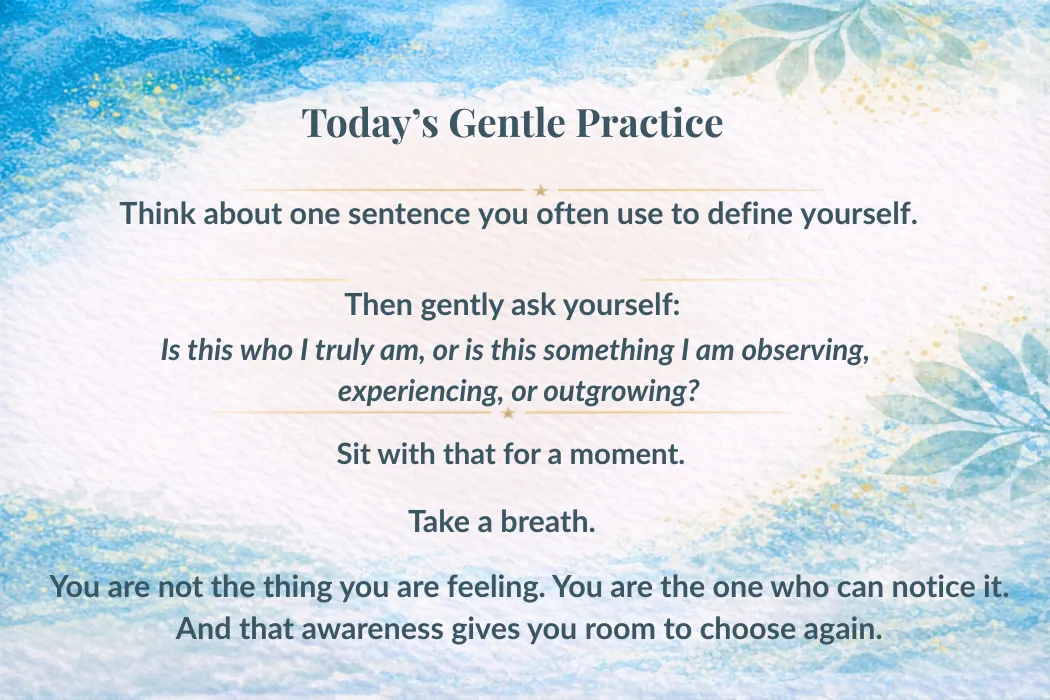
Today's Gentle Practice
Think about one sentence you often use to define yourself.
Ask yourself:
Is this who I truly am, or is this something I am observing, experiencing, or outgrowing?
Maybe it's an emotion.
A role.
A story.
A label someone gave you.
A version of yourself you've repeated for years.
Let yourself step back from it for a moment.
You are not the thing you are feeling.
You are the one who can notice it.
And that awareness gives you room to choose again.
With you,
Lynn
Join me on Substack and read Letters from The Threshold


