
Day 290: Let Me See Who You Are Today
Two days ago, the workbook lesson in A Course in Miracles was: Let me forget my brother's past today.
That sentence has stayed in my head for two days.
I keep thinking of things related to it. Stories, examples, effects.
First, what came up for me was that it's asking us to give people grace, just as we would hope they give us.
Second is judging. Judgment prevents us from forgetting.
Then there's the issue of I can forgive you, but I won't forget when we feel we've been wronged. Do we really want others to hold everything we've ever done against us for life? No. So why would it be ok to do it to others?
The majority of our judging is based on the history, the past, of whoever or whatever we're judging because judging doesn't happen in a vacuum. It's relational to everything we know about that person or that entity from the past.
When I was a senior in high school, I moved to a town that had, I think, 13,000 people in it. It wasn't very often that someone new moved into this town. Everybody there had grown up together, and most of their parents had all grown up together. There was a lot of history, a lot of judgment. Nobody was forgetting anybody's past.
When I met my new boyfriend, who later became my first husband, we met at a party. I was immediately smitten. I saw all these wonderful qualities in him that emerged while we were at this party.
The very next day, people started coming to me that I didn't even know, telling me why it would be wrong for me to date him, telling me things he did in the third grade. I was flabbergasted.
I'd never lived in an environment like this, and I thought, "Wow, these people are so judgy."
I had no idea it was just a community that knew everything about everyone; it seemed. Obviously, 13,000 people didn't all actually know each other. But in my 17-year-old brain, that's what this was telling me.
And it almost immediately dawned on me, "They cannot see who he has grown into from the date of these judgments that each of them had shared, to who he is now."
They've stuck him in a box of who he was in the moment of the incident that they're basing their judgment on and that carries forward forever in their minds. That's who he is.
We naturally do that in our families, in our long-term friendships, in our work environments where we have some kind of history with people. I don't care if it's somebody that you just met 2 weeks ago. You already have judgments based on the interactions and your observations of this person.
That's how our brains work. The brain tries to find similarities so they know what to do with the information it's gathering. It has to make sense out of it and so it makes judgments.
If we become aware that we do that, and then ask ourselves if we are solely looking at this current interaction or are we bringing the past into it to color the situation, the honest answer is probably yes.
Now, that doesn't mean we throw away everything we've learned about someone, especially when their behavior has shown us that we need to protect ourselves.
We can release our judgment of who someone is without giving them the same access to our lives that they once had. Releasing judgments and discernment can exist together.
What we're looking at here is our willingness to allow people to be different from who they were when we formed our opinion of them. How often do we actually give someone that room, especially when we've known them for years?
Now imagine what it would be like if you suddenly had amnesia and you completely forgot everyone's past right up until today. This next interaction that you have with them: everything is wiped out and you're interacting with them for the first time.
The only thing you have to go on is your current feelings and emotions as you interact with that person in the present.
It would be shocking how different our interactions would be if they weren't majorly dependent on our feelings about that person from the past, even if that past is from what they did yesterday when we first met them.
Now, I want to make something very clear because this is important. When we're talking about forgetting someone's past, we're not talking about forgetting the things we've learned that protect us from danger.
When I finally reached the point where I could forget the past of my abuser, it meant that I had removed the emotion from those memories. I could remember what happened without experiencing the pain and fear that had been attached to that part of my life.
That was freedom for me.
But it doesn't mean that if I encountered him today, I would greet him warmly and act as though nothing had happened. I would still protect myself and make sure I wasn't anywhere near him.
I no longer need to carry the emotional weight of what happened, but I haven't lost the wisdom that came from living through it.
There's a big difference between releasing the past from your emotional life and allowing the past to repeat itself in your physical life.
We can release our judgment, and free ourselves from the emotional hold of an experience while still maintaining the boundaries that keep us safe.
And that's what this lesson has had me thinking about for two days.
How many people in our lives are we still seeing through the lens of something that happened years ago? How many of our conversations are influenced by something we expect them to say or do before they've even opened their mouths?
And how many people are doing the same thing to us?
We've all grown and changed. We've all said and done things we wouldn't say or do today. We've learned lessons, developed greater awareness, and become different versions of ourselves through our experiences.
Yet we can continue interacting with one another as though none of that growth has taken place.
The Course is asking us to become willing to see beyond the history we've attached to someone. We can remember what we've learned from our experiences and still allow the person standing in front of us to be who they are today.
Imagine how much lighter our relationships could become if we stopped bringing every old judgment into each new interaction.
And imagine what that would feel like if the people in our lives offered us that same grace.
Let me forget my brother's past today.
That's a practice worth repeating.
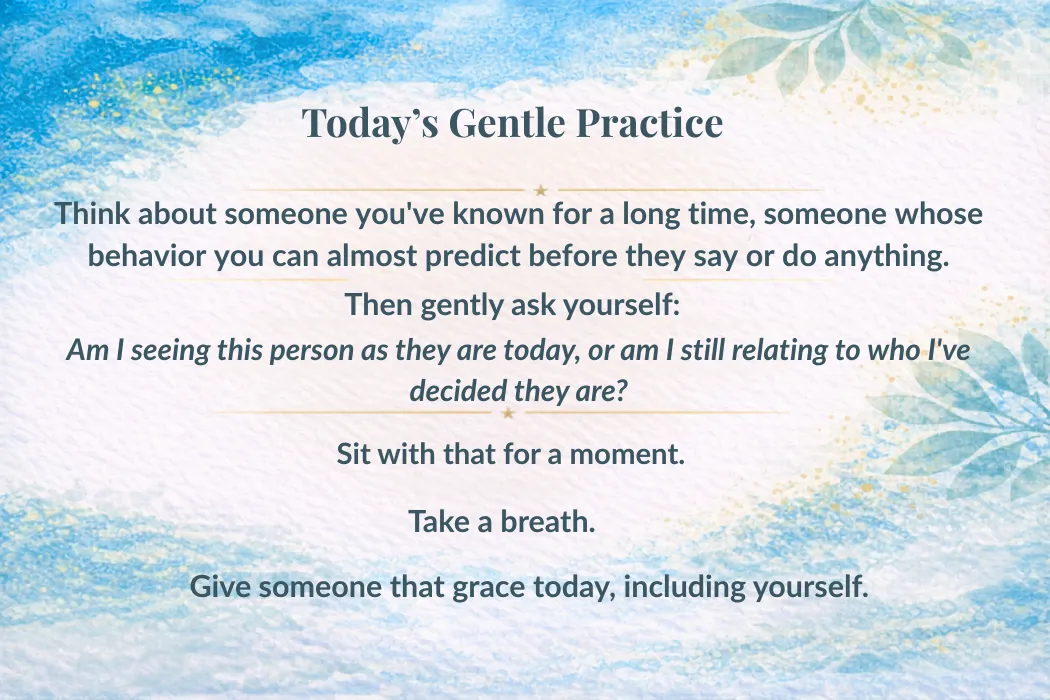
Today's Gentle Practice
Think about someone you've known for a long time, someone whose behavior you can almost predict before they say or do anything.
Ask yourself:
Am I seeing this person as they are today, or am I still relating to who I've decided they are?
Notice what expectations you bring into your interactions.
Consider whether you're allowing room for the person to have grown or changed.
You can honor what you've learned from the past while staying open to what is true in the present.
Give someone that grace today, including yourself.
With you,
Lynn
Join me on Substack and read Letters from The Threshold


